The History of Mah Jongg
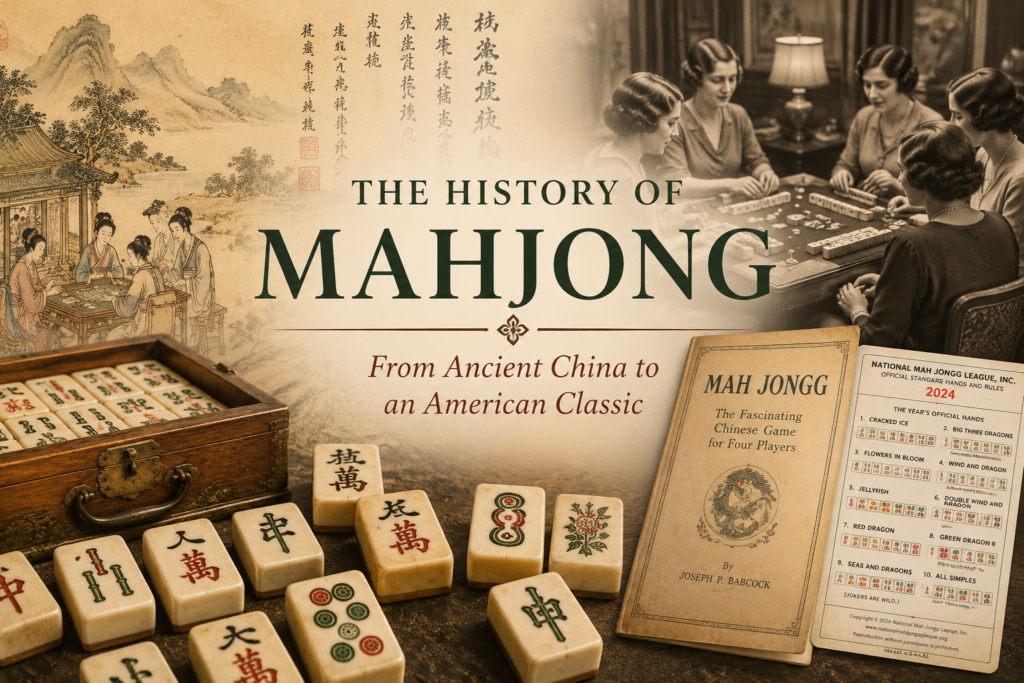
Mahjongg is one of the world’s most enduring and fascinating games, combining skill, strategy, memory, and a measure of luck. Its origins can be traced to China during the Qing Dynasty, although historians continue to debate the exact date and circumstances of its creation. Most evidence suggests that the game developed during the mid-to-late nineteenth century from a variety of older Chinese card and tile games. By the late 1800s, Mahjongg had become a popular pastime among the Chinese upper and middle classes, particularly in the bustling cities and trading centers of eastern China.
The game is traditionally played with a set of 144 tiles featuring suits, honors, flowers, and seasons. Players draw and discard tiles in an effort to complete specific combinations that form a winning hand. Unlike many Western games, Mahjongg requires players to balance offensive and defensive strategies while carefully observing the actions of their opponents. This combination of complexity and social interaction helped the game spread rapidly throughout China.
Mahjongg first gained international attention in the early twentieth century. Western businessmen, diplomats, and travelers visiting China became intrigued by the game and began bringing sets home as souvenirs. In the 1920s, Mahjongg experienced a remarkable boom in the United States. Entrepreneurs imported thousands of tile sets and published books attempting to standardize the rules for American players. One of the most influential figures in this effort was Joseph Park Babcock, an American businessman who simplified and published a version of the game’s rules for Western audiences. His publications helped ignite a nationwide Mahjongg craze that swept through American cities during the Roaring Twenties.
Although the initial popularity surge eventually subsided, the game maintained a loyal following. As Mahjongg spread through immigrant communities and social clubs, players began adapting the rules to suit their preferences. Over time, a distinctly American version of the game emerged. The most significant development occurred in 1937 with the formation of the National Mahjongg League (NMJL). The organization sought to standardize gameplay and create a common set of winning hands that could be used nationwide.
The American version differs substantially from traditional Chinese Mahjongg. While Chinese variants generally allow players considerable flexibility in constructing winning hands, American Mahjongg relies on an annually updated card issued by the National Mahjongg League. This card specifies the exact combinations that constitute winning hands for that year. Players must therefore adapt their strategies each season as the official card changes.
American Mahjongg also introduced several unique elements, including the use of Joker tiles and a greater emphasis on specific hand patterns. The game became particularly popular among women’s social groups, community centers, and retirement communities throughout the United States. Today, it remains a vibrant social activity enjoyed by players of all ages and backgrounds.
From its origins in nineteenth-century China to its evolution into a uniquely American pastime, Mahjongg has demonstrated a remarkable ability to adapt while preserving its essential appeal. Whether played according to traditional Chinese rules or the American format established by the National Mahjongg League, Mahjongg continues to bring people together through competition, strategy, and friendship more than a century after its introduction to the West.